
Coaching – Why getting External Support is Essential to Living an Empowered Life
During these gloomy rainy days lately, I was feeling a bit under the weather (literally) and fell for the Netflix targeting; so I watched the recent Beckham documentary (as I’m sure a lot of you have). While it was intriguing to learn about David Beckham’s life (especially the behind-the-scenes interactions with Victoria), what I found most spectacular was his resilience in the face of adversity. Despite the many obstacles thrown his way, he kept showing up.

This got me thinking: Apart from his own drive and ambition, his career was strongly impacted by his coaches. So if Beckham had not had the coaches he did, would he have been as successful? And what about the coaches throughout my life? If I had not started to work with a coach about one year ago, would my path look differently now?
I can say with certainty that coaching has changed my life for the better. If it was not for coaching and becoming clear about my goals, I probably would not have launched this blog. Which is why in this post I’m exploring the concept of coaching and why external support is essential to living an empowered life. Let’s start with some basics:
the basics
What is Coaching?
Simply put, coaching is “the process of training someone to play a sport, to do a job better, or to improve a skill” (Oxford Dictionary, 2023). In a constantly shifting environment, work and personal life demand learning and reskilling.
In the workforce, there are often two types of coaching: internal and external. Internal coaching is done within the organization, where a manager acts as a coach for the team. External coaching is done by an expert in the field in which coaching is being given, however the coach is not a part of the corporation. But no matter the industry or line of business, I would like to emphasize that coaching is for everyone.
Working with a neutral yet trained professional in a process of self-discovery and self-awareness, helped me to identify strengths and develop goals, as well as proactively build new skills. Coaching helped me to grow both professionally and personally and seeking it was essential for me in order to live an empowered life.
A coach is someone who tells you what you don’t want to hear, who has you see what you don’t want to see, so you can be who you have always known you could be.
Tom Landry
According to data collected from the coaching platform BetterUp, on top of personal and professional growth, coaching can have multiple benefits such as: reduction in burnout, increase in social connections and flow of feedback as well as an improvement in mental health, fitness and stress management.
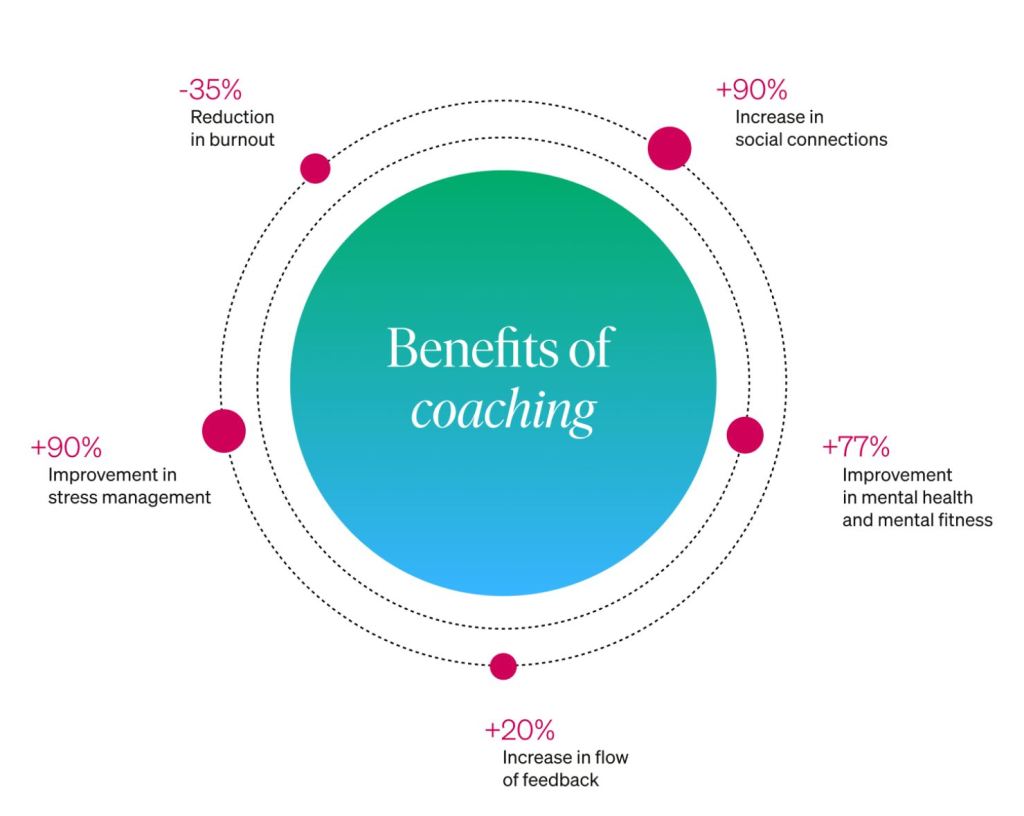
Based on my own experience, while the benefits of coaching are immense, it also has its limitation. Hence, the line between coaching and therapy can sometimes be a blurry one. Only when we become open and vulnerable with ourselves, can we truly discover what is blocking us. If we recognize we suffer from certain behavioral patterns, fears, anxiety or depression, then seeking out additional, medical help might be required and it could be time to consider therapy.
What is Therapy?
Therapy is clinical mental health care to help individuals manage and reduce symptoms of mental illness. Therapists are licensed by the state and have a degree along with the respective state credentials.
Unlike coaching which focuses on the here and now, therapy focuses on healing the past. Therapy treats mental health conditions, and helps with personal and family issues. When considering coaching vs. therapy, think of what type of clinical or mental health support you may need.
Mental health…is not a destination, but a process. It’s about how you drive, not where you’re going.
Noam Shpancer
However, sometimes it is neither coaching nor therapy that is needed. In fact, when it comes to our professional development one should not overlook the people whom we look up to and who we trust to guide us through certain phases in our lives. They don’t take on the role of a coach or therapist but come in the form of a mentor.
What is Mentorship?
Mentorship is a relationship focused on career and professional growth. Oftentimes, mentors consult and advise on professional challenges. They can also help encourage new ways for you to grow and develop in your career.
A mentor is someone who allows you to know that no matter how dark the night, in the morning, joy will come. A mentor is someone who allows you to see the higher part of yourself when sometimes it becomes hidden to your own view.
Oprah Winfrey
Deciding Between Coaching, Therapy and Mentorship
First of all, I think it is worth exploring who in your life functions as a coach, therapist or mentor. With that information, you can create your own board of directors and see who should have an advisory seat at your table. Based on my experience, the table should not exceed six seats (including your own). Once you have defined your internal group of trustees, it is time to decide what expertise might be missing from your table.
If you are working towards a promotion and require some senior experience, it might be worth seeking a mentor within your organization or field. If you have been struggling with your mental health, experiencing anxiety for instance, it could be beneficial to consult a therapist. Or, as in my case, I noticed I felt stuck and was missing clarity. So, I found an external coach via work who helped me become clear on my goals (eg. change jobs, learn Spanish, start a blog and write a book).

Overall, I think none of the three – coaching, therapy and mentorship – are mutually exclusive. However, seeking out all three all at once might be overwhelming. In general, seeking external help can be scary, so starting with a first free consultative session is a good way to get the ball rolling.
How to Find the Right Coach
Now you might wonder how to begin this process, so here are a few steps on how to find the right coach:
1. Determine your needs. What is it that you need help with? Is it your life, career, sports, diet, etc.?
2. Define your budget. Seeking professional help is not cheap. Check with your employer whether they have any learning & development budget that might cover the cost. Ask your health insurance if they offer financial help.
3. Find a coach. There are platforms online that offer a service to match you with one. The two services I have used in the past and that I can strongly recommend are: CoachHub and BetterUp. If you choose either one of them, the experience is similar to online dating. You fill out your persona, what you’re looking for in a coach: industry, age, gender, expertise, etc. and the software matches you with a few suitable candidates to choose from. If you’re not pleased with their suggestions, you can always request more options. Alternatively, you can check out the International Coaching Federation. They are available in multiple countries and allow you to find coaches in your country. If online coaching is not for you, it might be worth to tap into your local network.
Personally, coaching has an immense impact on my life, well-being and mental health, hence I’m a huge advocate. Getting a coach might not have made me the next David Beckham but it did enable me to take the next step in bringing me closer to a fulfilled and empowered life. Evidently, that is what I wish for you. As this topic is not only a personal one but also one I’m very passionate about, if you have any questions regarding my coaching experience, or you would like me to connect you to some of the coaches I know, feel free to comment or reach out.
Sincerely, The Blonde Yeti 


 The Blonde Yeti
Leave a comment